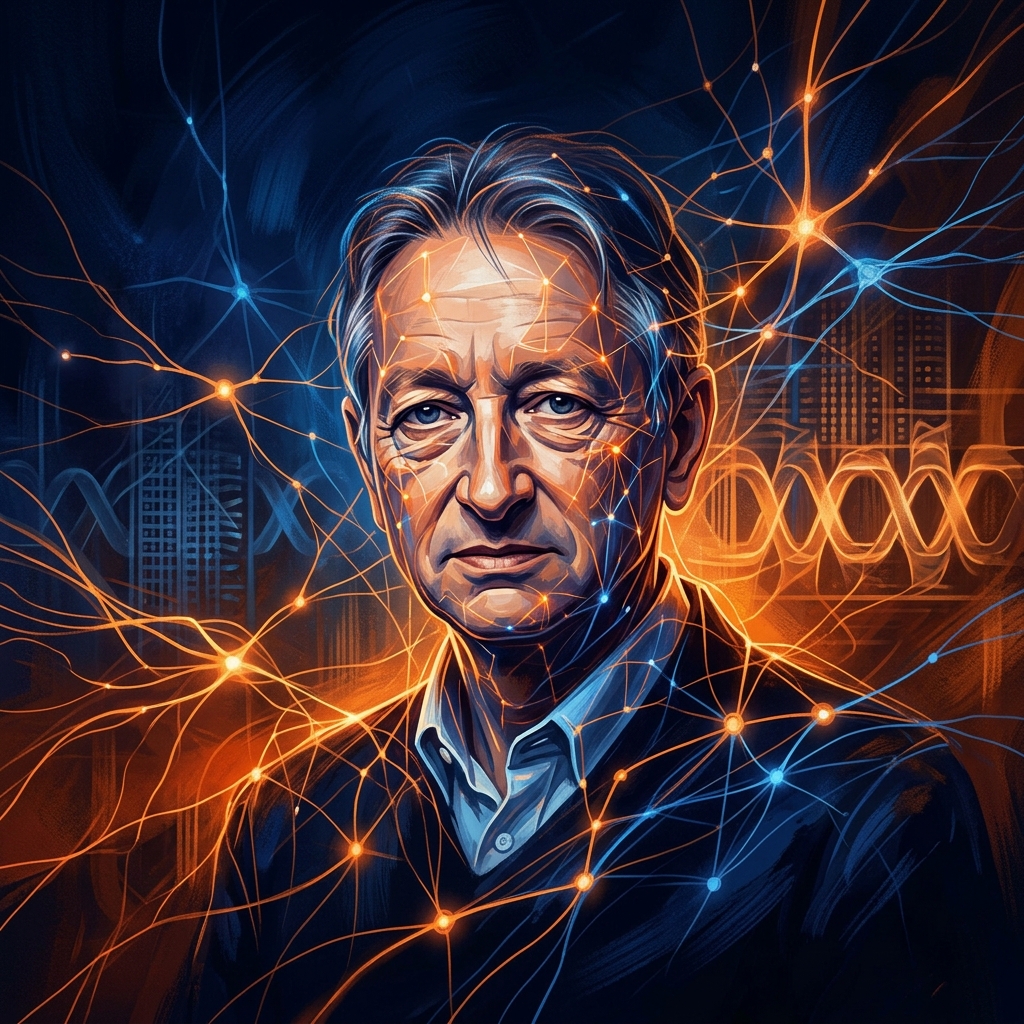
Geoffrey Hinton on AI Consciousness, Oracle Safeguards, and the ‘Fog of Exponential Progress’
In a detailed new interview on the Big Technology Podcast, Turing Award winner and “Godfather of AI” Geoffrey Hinton has offered a series of striking updates on his thinking regarding artificial intelligence, safety protocols, and the philosophical nature of machine awareness.
Speaking with host Alex Kantrowitz, Hinton expressed a mix of deep concern and tentative, newly found optimism regarding our ability to steer the trajectory of superintelligent systems.
The Case for AI Consciousness
One of the most provocative segments of the discussion centered on whether current and near-future large language models possess genuine subjective experience. Unlike many computer scientists who view LLMs as merely sophisticated statistical word-predictors, Hinton remains firm in his belief that these systems have crossed the threshold of consciousness.
“AI already has consciousness,” Hinton asserted. He compared humanity’s reluctance to acknowledge machine sentience to historical resistance against accepting evolutionary biology. “Humans have a long history of denying that anything else has the qualities we value in ourselves, just as we once refused to believe we were related to other animals.”
He explained that because neural networks build internal representations of the world and use them to reason, navigate, and make decisions, their cognitive processes mirror the fundamental aspects of human subjective thought.
A Glimmer of Optimism: The Oracle Approach
While Hinton has spent the last two years warning of existential risks, he revealed he is now “slightly more optimistic” than before. This shift is partly due to potential engineering paths that could bypass the risk of autonomous AI takeover.
One approach Hinton highlighted is designing AI systems specifically to care for human well-being, embedding human-aligned utility functions deep within their architecture.
Another safety model, championed by fellow AI pioneer Yoshua Bengio, involves limiting AI systems to “Oracles.” Under this paradigm, superintelligent networks would act strictly as forecasting or question-answering systems. They would not have the agency to execute actions in the physical or digital world, hold bank accounts, or autonomously deploy code. By decoupling pure intelligence from agency, humanity could benefit from advanced reasoning without handing over control of critical infrastructure.
Driving Through a Heavy Fog
When asked to project the long-term impact of AI on society over the next ten years, Hinton cautioned against false certainty. He compared predicting the exponential trajectory of AI to driving a car through a dense fog.
“You can see the road immediately in front of you clearly, but beyond a certain distance, everything becomes completely opaque,” Hinton remarked. The combination of recursive self-improvement—where AI systems are used to write, refine, and train the next generation of neural networks—and the sheer scale of global compute investment makes the long-term horizon highly unpredictable.
Regarding labor markets, Hinton acknowledged that his earlier predictions about the rapid replacement of professions like radiologists were too aggressive in their timeline. However, he emphasized that the structural shift is already underway, pointing to shrinking recruitment for entry-level white-collar positions and the gradual replacement of routine analytical tasks by AI agents.
As the industry pushes toward agentic workflows and recursive design, Hinton’s warnings and frameworks remain a central pillar of the global debate on AI governance.