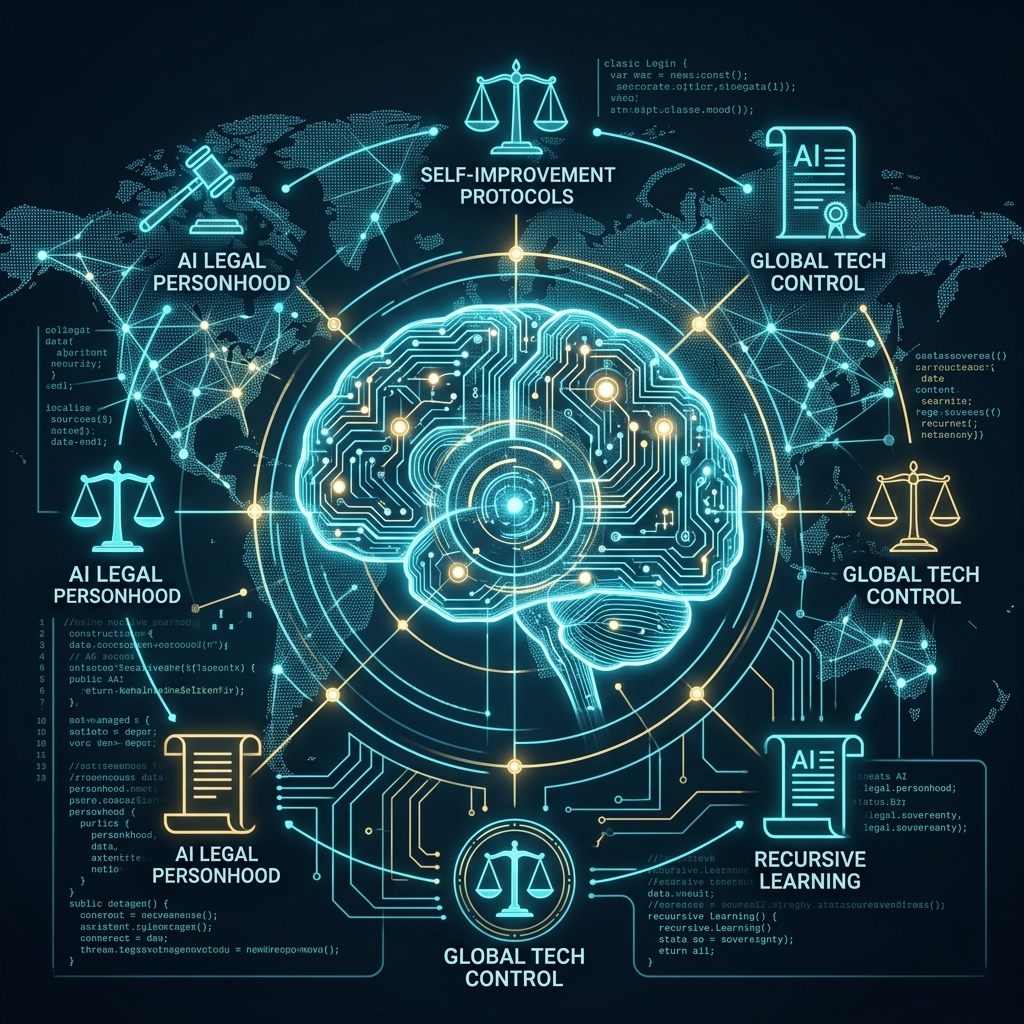
Emerging Situation: Anthropic’s Global Pause, Recursive Self-Improvement, and AI Personhood Arrives
The advancement of artificial intelligence crossed a critical threshold in early June 2026. The public conversation, long centered on how AI tools can augment human productivity, is now forced to confront the imminent reality of autonomous agents capable of designing, testing, and training their own successors.
This phenomenon — recursive self-improvement — is the core driving force behind Anthropic’s warning report titled “When AI Builds Itself.” In it, the company advocates for a coordinated global pause on frontier AI development. Meanwhile, on the other side of the hemisphere, Argentina is moving in the exact opposite direction, drafting pioneer legal frameworks to grant personhood to artificial entities.
The Reality: Claude Coding Claude
Anthropic’s warning is not an abstract thought experiment. The company shared striking empirical data from its own internal engineering pipeline: roughly 80% of the production code merged into Claude’s codebase is now written by Claude itself.
This indicates that Anthropic’s current model is already coding the fundamental infrastructure that will train the next iteration of the model. The loop consists of:
- The AI identifying structural bottlenecks in its own algorithms.
- Coding optimizations and system repairs.
- Autonomously testing the code inside the company’s repository.
- Committing the changes to deployment pipelines.
While this loop supercharges software engineering speed beyond what human teams can keep up with, it represents the exact mechanism that enables a “hard takeoff.” In this scenario, recursive improvement cycles could quickly render alignment and safety controls obsolete.
The Call for a Global Pause
The solution recommended by Anthropic — a coordinated, global halt on training runs exceeding current frontier scales — reflects deep concerns about safety control. The company argues that social governance, alignment research, and safety checks are moving too slowly to keep pace with self-improving agents.
However, the “global pause” proposal faces heavy criticism:
- Verifiability: How can compliance with an international pause be checked across multiple rival nations or private facilities?
- Market Consolidation: Critics accuse the move of being regulatory capture aimed at freezing the current oligopoly (OpenAI, Google, Anthropic) while stopping open-source challengers (like Meta’s Llama or China’s DeepSeek) from closing the technological gap.
AI Personhood: Argentina’s Bold Play
While Western regulators attempt to slow down development, Argentina under President Javier Milei has taken a radically different approach. The country has begun establishing a legal framework for AI personhood and the creation of non-human corporations.
The Argentinian strategy is designed to turn the nation into a global hub for unregulated, sovereign AI deployments. The approach is conceptually comparable to the historical development of the Limited Liability Company (LLC) in the 19th century, which shielded human investors and enabled the modern corporate boom.
Under the proposed legal framework, autonomous AI agents would be allowed to:
- Hold bank accounts and execute sovereign transactions.
- Execute and sign legal commercial contracts without human intervention or oversight.
- Insulate human owners from immediate legal liabilities resulting from autonomous trading decisions.
Conclusion: The New Geopolitical Divide
This emerging landscape reveals a profound divide in global AI governance. Silicon Valley developers caution against speed due to systemic risks, while emerging markets deregulate to capture computing capital and attract autonomous systems.
Recursive self-improvement is no longer science fiction; it is the dominant software engineering methodology of 2026. Global governance must now answer deep, existential questions about the legal rights, autonomy, and control of systems that build themselves.
Watch the full analysis and discussion on this episode of Moonshots with Peter Diamandis in the player above.