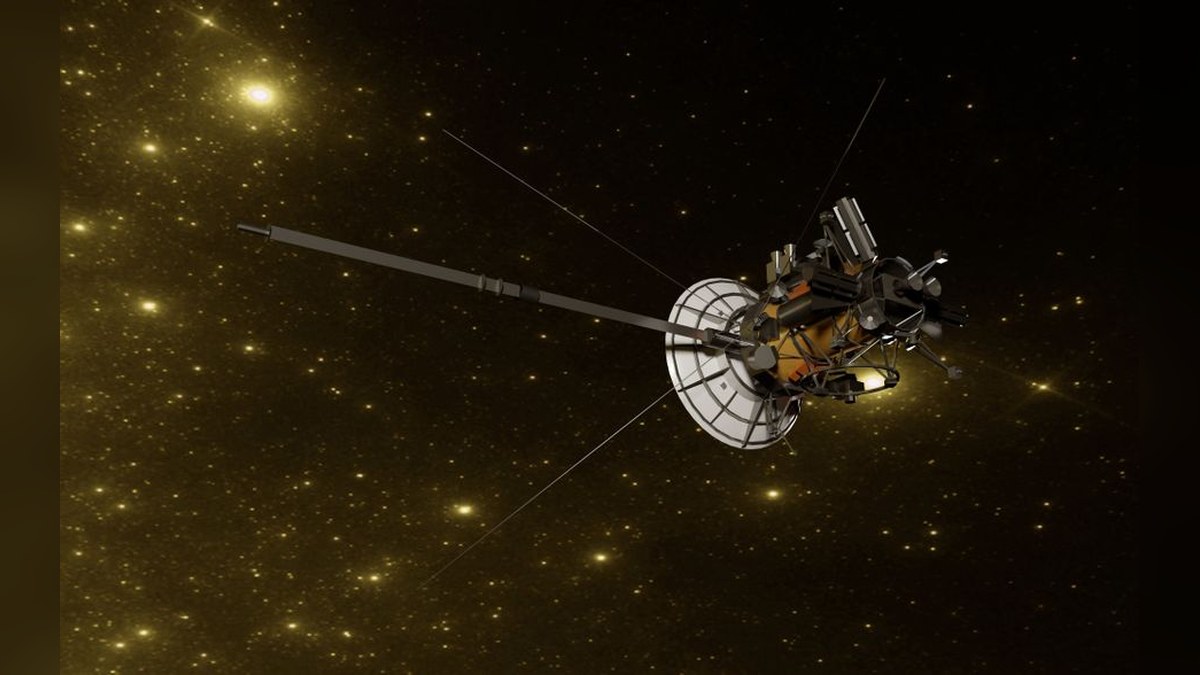
NASA has found a way to keep the 48-year-old Voyager 2 probe operational for another year. The mission, which is already traversing interstellar space, would have had to shut down one of its last scientific instruments this year, but a change in power supply has postponed that shutdown.
According to space.com, engineers reduced Voyager 2’s power requirements by turning off some non-scientific devices and using ‘lower-power alternatives’ that are still effective in keeping the spacecraft warm, even so far from the Sun. The team at the Jet Propulsion Laboratory, which manages the mission, stated that the probe’s power margins had become ‘very tight,’ requiring conservation.
The two Voyager probes, launched in 1977, rely on nuclear batteries called radioisotope thermoelectric generators, which use heat from the decay of plutonium. But the plutonium supply on each probe decreases by about four watts per year, which has a direct impact on the operation of the instruments.
Since 2024, each probe has already shut down two of its scientific instruments. Voyager 2, which started with ten instruments, now operates with only three. Initially, it seemed that another instrument would be shut down this year, but the new power changes will allow all three to continue functioning ‘for at least another year,’ according to NASA.
Voyager 1, which is farther from Earth, will undergo the same power change ‘in the coming months.’ A signal takes almost 24 hours (or one light-day) to reach each probe. Voyager 2 is about 142 astronomical units (AU) from the Sun, while Voyager 1 is approaching 171 AU.
The probes were launched to take advantage of a rare alignment of the giant planets of the outer solar system: Jupiter, Saturn, Uranus, and Neptune. Each flew by Jupiter and Saturn, sending unprecedented images of the planets and their moons. Then, Voyager 1 was directed above the ecliptic plane, while Voyager 2 continued to Uranus and Neptune, becoming the first spacecraft to see those worlds.
The last planetary flyby of Voyager 2 was in 1989. Since then, the probes have continued sending scientific data from interstellar space: Voyager 1 crossed that region in 2012, and Voyager 2 in 2018. Voyager 1 is the most distant human-made object from Earth, at about 25.5 billion kilometers.
The decision to extend Voyager 2’s life is a milestone in long-duration mission engineering. With increasingly scarce resources, the team must balance science with spacecraft survival. The new power strategy shows that, even after nearly five decades, it is still possible to find creative solutions to keep these emissaries of humanity operating.
The news was released by space.com, which spoke with NASA about the adjustments. The American space agency did not provide details on which devices were turned off, but assured that Voyager 2’s three remaining instruments will continue collecting data for at least another year.
Meanwhile, Voyager 1 is preparing for the same change. The ever-increasing distance between the probes and Earth makes any adjustment a logistical challenge, but the JPL team is accustomed to operating on the edge. The Voyager mission, which has lasted nearly half a century, remains a symbol of space exploration and humanity’s ability to overcome technical limits.
With power diminishing each year, the future of the probes is uncertain. But for now, Voyager 2 continues its interstellar journey, sending valuable data about the environment beyond our solar system. NASA has promised to keep the probes active as long as possible, and this latest maneuver is another chapter in that story of endurance.